Wednesday, August 05, 2009


Double-sided entrelac join... redux
Tuesday, August 04, 2009
Sliding-loop entrelac join, two-sided
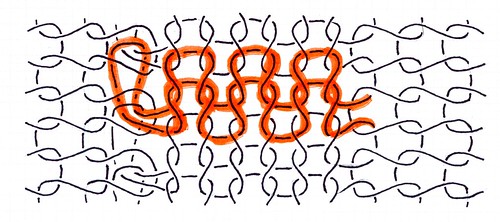 Sliding-loop entrelac join, two-sided, originally uploaded by fuzzyjay.
I've never been totally happy with the way that entrelac joins look. To reduce bulk to a minimum, and to keep the stitches from looking too distorted, I have been using sliding-loop joins to connect pieces of knitting at right angles to each other, as in entrelac. When doing closed-form entrelac (such as a cube) there are times when you have to join three pieces together. Until a few days ago, I couldn't think of how to do that without decreases.. Then voila, it hit me. Here's how the structure looks. The pieces of knitting on both sides have live stitches (loops held on a needle or holder). In other words, the direction of knitting for them is toward the center. Pull a loop (one of them is shown in orange) through one of the raw stitches belonging to the piece on the right. This will secure the right piece of knitting to the center piece. Knit with the loop (knit rows going from right to left). Purl back (left to right), but before you do that, use the loop formed by turning the row to go through the knitted piece on the left, and chain these loops to each other, behind the fabric, to secure the left knitted piece to the center knitted piece. Soon, I'll describe the knitting operations to do this.
